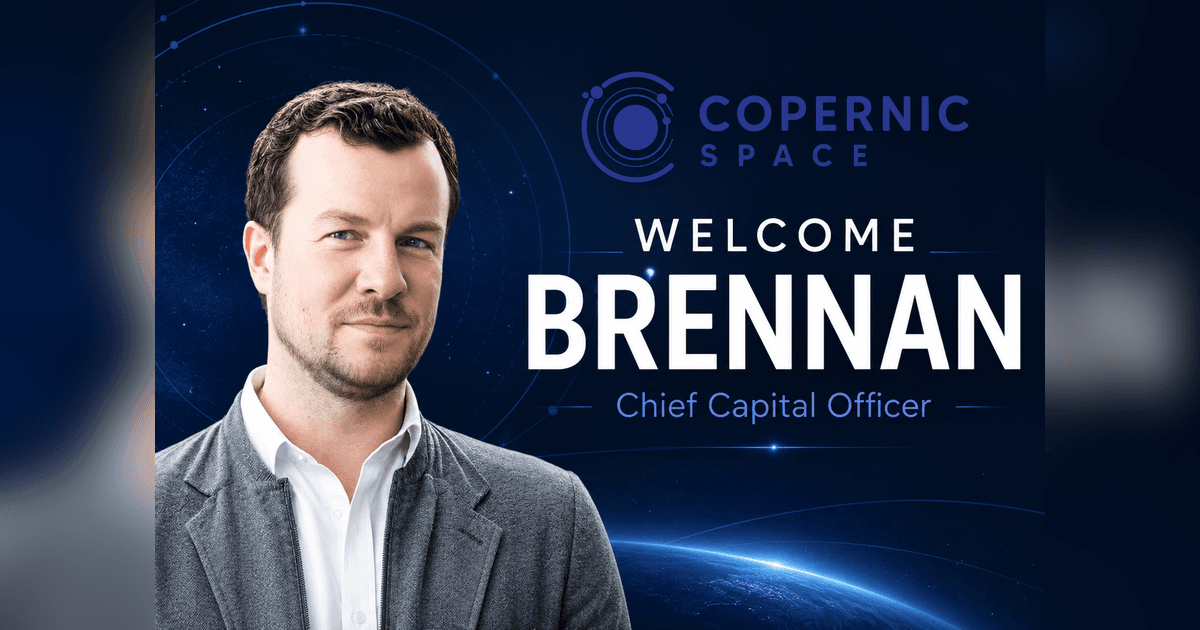
Message From Our Chief Capital Officer: Meet Brennan Plaetzer
I'm excited to join Copernic Space as Chief Capital Officer. Copernic Space is the pioneer in creating the financial market for space assets, building the infrastructure needed to turn the rapidly growing space economy into an accessible and investable asset class.
Every major asset class eventually builds its own capital markets.
Real estate didn't become a global asset class because we built more buildings. It became one because we built mortgages, title systems, appraisals, benchmarks, insurers, REITs, and custodians.
Oil wasn't transformed by drilling alone. It was transformed by futures markets, project finance, and insurance.
The same story played out in shipping, aviation, telecommunications, and renewable energy. In every case, the infrastructure that finally scaled the industry wasn't physical. It was financial.
I believe the space economy is arriving at that moment, and I'm glad to share that I've joined Copernic Space as Chief Capital Officer to help build it.
Launch costs keep falling. Commercial satellites are proliferating. Private companies are building lunar missions, space stations, in-orbit servicing businesses, and entirely new categories of infrastructure.
The money side has not kept pace. Almost all of it is still financed through three channels: venture equity, government contracts, and one-off bespoke transactions. Ask the questions an institution would ask, and the gaps appear immediately. How do you value a satellite data contract? How do you compare one space asset to another? How is ownership tracked, financed, serviced across a fifteen-year life, and eventually sold?
Today there are no standard answers. Real estate has deeds, appraisals, and a property market. Equities have tickers, indexes, and exchanges. Space has none of the three, which is a remarkable thing to say about an economy this size.
Copernic Space is building that layer: a system through which real space assets and contractual rights can be identified, structured, financed, owned, benchmarked, serviced, and eventually traded. Mission and payload capacity. Satellite and infrastructure interests. Data and communications rights. Revenue-producing contracts, and the equipment and facilities behind them. The simplest framing is Space Asset Finance Infrastructure, and ultimately a foundation for Space Capital Markets.
Many people associate Copernic with tokenization. I think that undersells it. Tokenization is one technology. Capital markets are an entire ecosystem, and that is the build.
It also isn't theoretical. The company has already demonstrated the model through real missions, including the commercialization of assets connected to a lunar mission that generated revenue and delivered returns to participants. That proved economic rights tied to space assets can exist and perform. It has also completed sold-out offerings connected to reusable rockets and built a growing pipeline across lunar missions, satellite data, orbital compute, payloads, and other emerging space asset categories. The next chapter is the financial infrastructure around those rights, made repeatable, standardized, and institutional.
For operators, that means financing missions, payload capacity, data rights, and infrastructure without relying entirely on venture equity. For investors, it means the identification, documentation, pricing, diligence, reporting, and servicing required to underwrite a new asset class with real confidence. For the broader ecosystem, it means the connective tissue that turns a collection of bespoke projects into a functioning capital market.
My work sits at the intersection of capital formation, asset structuring, and institutional market development: building a repeatable framework for financing space assets, translating complex space transactions into financeable structures, establishing underwriting and servicing standards, and creating pathways for family offices and institutions to participate.
Most of my career has been spent where new markets, complex assets, and capital intersect. Markets begin to scale when information becomes standardized, risk becomes measurable, transactions become repeatable, and investors can trust the infrastructure surrounding an asset.
We are still early. But if history is any guide, some of the largest companies created over the next decade won't build space technology. They'll build the infrastructure that allows capital to flow into space at global scale.