
SpaceX IPO: Why the Real Opportunity Begins After the IPO
The SpaceX IPO gave the global capital markets something the space industry has been waiting decades for: a public reference price for space infrastructure at full institutional scale.
SpaceX raised roughly $75 billion at around $135 per share, entering the public markets near a $1.75 trillion to $1.77 trillion valuation before quickly pushing beyond the $2 trillion market value threshold after its debut. For years, space was treated as a government domain, a defense category, or a specialized venture bet. The IPO changed the frame. Space is now being priced as infrastructure.
The more important question begins after the IPO. Once public markets have priced SpaceX, where does the new liquidity go? Where do employees, early investors, funds, operators, and institutions redeploy capital after one of the largest value creation events in the history of private technology? And which new category creators in the space economy are positioned to absorb that capital?
That is the market shift Copernic Space has been building toward for years: space moving from exploration to infrastructure, from infrastructure to assets, and from assets to markets. SpaceX validates the company layer. The next opportunity is the financial layer around missions, payloads, launch capacity, satellites, lunar assets, reusable rockets, data rights, revenue streams, and secondary markets.
The market has priced SpaceX. Now it has to price everything forming around it.
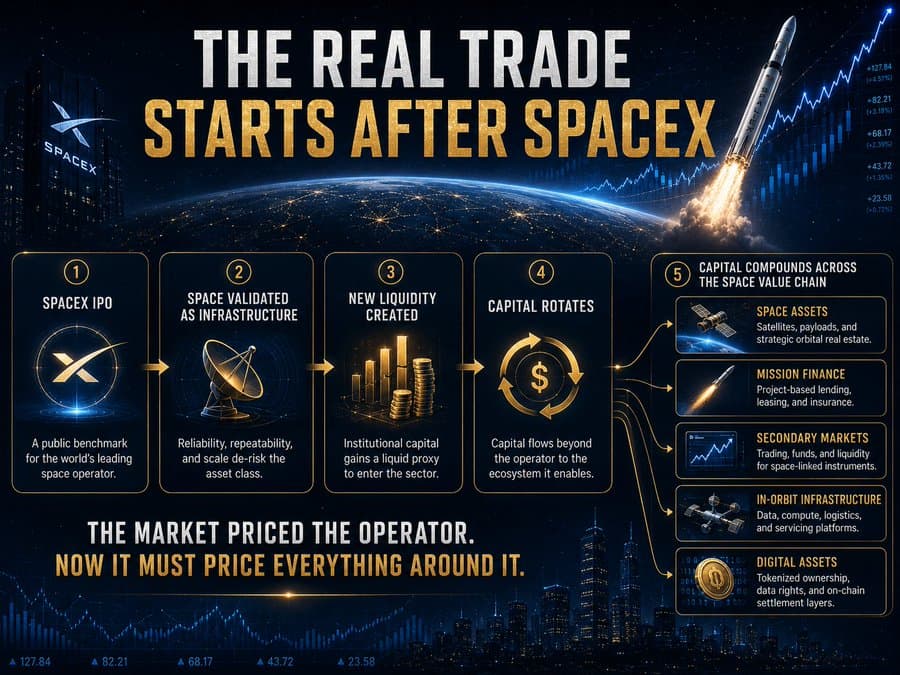
The Second Trade Is Where the Liquidity Goes
The most important part of the SpaceX IPO may be the liquidity created around it. A $75 billion IPO does more than bring new capital into one company. It converts years of private conviction into liquid or markable wealth for employees, early investors, venture funds, founders, operators, and institutions that backed SpaceX before public markets were willing to value space at this scale.
That matters because many of the biggest winners are not passive financial holders. They are the kinds of funds, operators, technologists, and strategic investors that tend to recycle frontier technology wealth into the next frontier. Founders Fund is one of the clearest examples. It backed SpaceX early, kept supporting the company over many years, and reportedly turned one of the boldest venture bets of the last two decades into one of the largest venture outcomes ever. DFJ Growth also became one of the great SpaceX winners, reportedly beginning with an early institutional position and investing hundreds of millions more over time. Valor Equity Partners and Antonio Gracias represent another category of winner: long-term, relationship-driven capital that stayed close to Musk's ecosystem and is now sitting on one of the most valuable positions in private market history.
Then there are the strategic and crossover investors. Google and Fidelity led a $1 billion investment round in SpaceX in 2015, a deal that looked enormous at the time and now looks like one of the great strategic technology investments of the era. Sequoia, Andreessen Horowitz, Baillie Gifford, Baron, Thrive, Vy Capital, and other long-duration investors gained exposure before the public market could.
This is the part of the IPO that most people underappreciate. The offering creates a new class of space-native liquidity. That liquidity will have to go somewhere. Some will move into AI, robotics, defense technology, advanced manufacturing, Bitcoin, crypto, and digital assets. A meaningful portion will stay close to the industry that created it. It will look for the next layer of space infrastructure, mission finance, satellite networks, lunar activity, reusable rocket opportunities, in-orbit services, data rights, and asset-level markets.
That is where the second trade begins. The first trade was SpaceX. The second trade is the ecosystem that becomes financeable because SpaceX proved the category.
This new capital will look for category creators in the space economy, not only for the next rocket company. It will look for companies building the missing layers around the infrastructure: financing, marketplaces, asset ownership, mission participation, secondary liquidity, and direct exposure to the economic activity of space. That is where companies like Copernic Space become relevant. The next wave of capital will not only ask which company can launch. It will ask who can make the space economy ownable, accessible, and liquid.
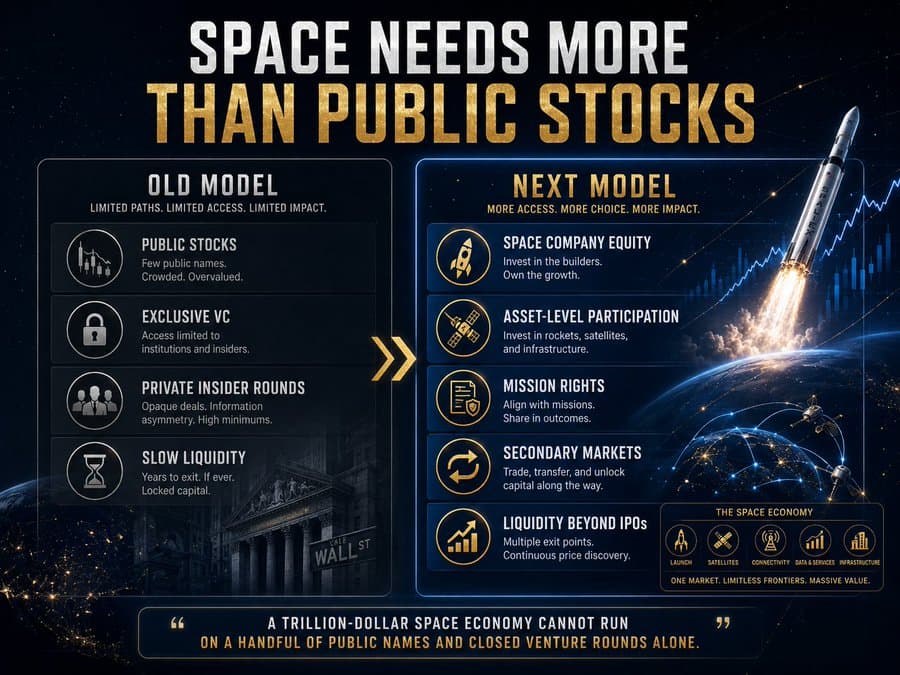
Visibility Is Not Access
The IPO made space visible to global capital. Visibility and access are different things. Buying SpaceX stock gives investors exposure to SpaceX. That matters, and equity in space companies will remain one of the key ways capital participates in the sector. But owning public equity in one company does not provide ownership of a specific launch window, payload allocation, lunar payload slot, satellite data right, reusable rocket opportunity, in-orbit compute asset, space-flown commercial object, or mission-linked revenue stream.
That is the structural gap in the market.
Before the IPO, meaningful space exposure was mostly locked behind a few gates: limited public equities, high-ticket venture funds, insider private rounds, government programs, defense relationships, strategic partnerships, and closed industry networks. If you were not a major fund, strategic investor, government buyer, billionaire, or someone deeply connected inside the industry, you were mostly watching from the outside.
The IPO changes the visibility of the sector, but it does not fully solve access to the underlying economic activity. The immediate takeaway is clear:
- SpaceX has validated the operator layer of the space economy.
- Public equity gives exposure to the company, but not the underlying assets.
- Venture capital remains too exclusive and illiquid to be the only private-market path.
- Space needs secondary markets around both company exposure and asset exposure.
- The next wave of value will form around access, liquidity, ownership, and yield.
- A real economy needs more than companies. It needs markets.
The Missing Layer Is Liquidity
The old space financing model was built for a smaller and more closed world. Government budgets are limited and political. Venture capital is selective, illiquid, and exclusive. Public markets only become available after a company reaches scale and can go through the intense public offering process. Private secondaries exist, but they are fragmented and still largely inaccessible. Mission rights, payload opportunities, satellite data streams, and infrastructure-linked assets often remain locked inside private contracts with no natural resale market.
That is not how mature infrastructure markets function. If space is becoming a trillion-dollar infrastructure economy, then it needs financial infrastructure equal to the scale of the opportunity. It needs more dynamic private markets for space company equity. It needs better secondary liquidity outside of public stocks. It needs asset-backed participation. It needs mission finance. It needs ways for investors to access space before IPOs, and ways for space companies to unlock value before selling the company or going public.
The next generation of space finance will need company equity beyond IPOs and closed VC rounds, secondary liquidity for private space company exposure, asset-backed participation in real space infrastructure, mission-linked rights and revenue participation, tokenized real world space assets, and markets for payloads, data rights, launch capacity, lunar assets, reusable rockets, and in-orbit infrastructure.
The technology is not the thesis. The market structure is.
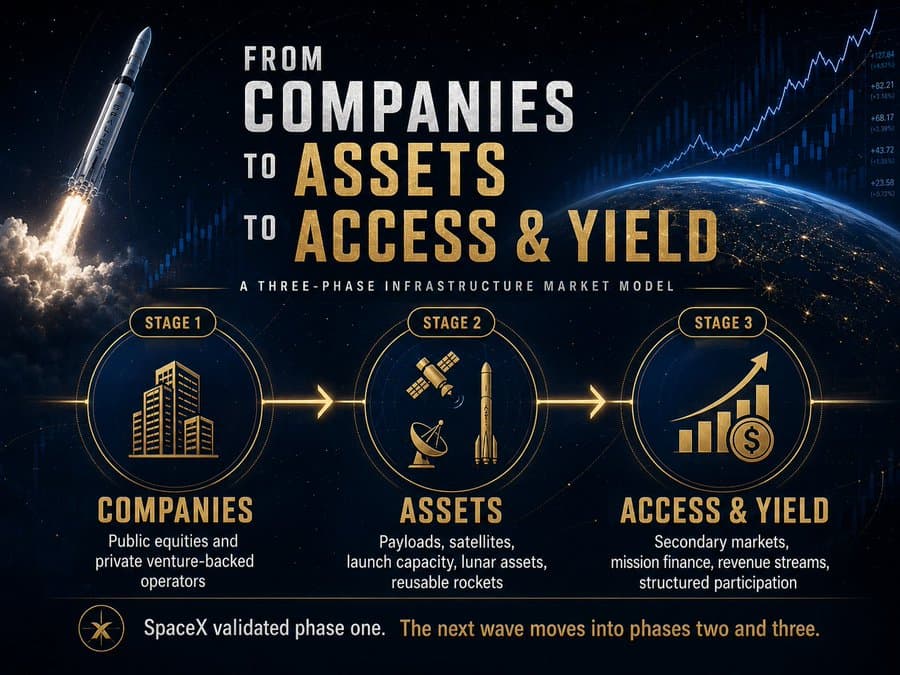
From Companies to Assets
Every major infrastructure market moves through a version of the same progression. First, capital buys the companies. Then it buys the assets. Then it buys access, utilization, and yield.
Real estate did this. Energy did this. Shipping did this. Telecom did this. Data centers did this. Cloud infrastructure did this. Early investors focus on the companies building the system. Later, the market matures and capital seeks exposure to the underlying buildings, pipelines, ships, towers, servers, bandwidth, capacity rights, usage rights, and cash flows produced by that infrastructure.
Space is now entering the same transition.
The SpaceX IPO validates the company layer at historic scale. The next phase is the asset layer. Payloads become assets. Launch capacity becomes an asset. Lunar payload slots become assets. Reusable rocket opportunities become assets. Satellite data rights become assets. Orbital compute becomes an asset. Space-flown commercial and luxury objects become assets. Mission-linked revenue streams become assets. Even private space company equity needs more dynamic secondary market infrastructure before the public listing stage.
This is where the market is still behind. Public equity is too broad to capture mission-level economics. Venture capital is too exclusive to democratize access. Traditional procurement is too slow to create liquid markets. Static contracts are too limited to support a global asset class.
Tokenization becomes relevant here because it can turn closed, complex, hard-to-transfer space rights into structured economic units. Done correctly, it supports ownership, verification, transferability, rights management, price discovery, and secondary liquidity.
Moon Mission I Proved the Model
Copernic Space has already seen early evidence of this demand.
Through Moon Mission I, participants were able to take part in a real lunar payload opportunity launched on a SpaceX Falcon 9 aboard Firefly Aerospace's Blue Ghost lander, which successfully landed on the Moon in 2025. The mission commercialized digital payloads, digital twins, payload rights, media rights, brand content, and participation tied to a real lunar event.
More than 2,000 assets were sold to hundreds of participants globally. Early liquidity providers realized approximately 3x ROI in under five months, and some fractionalized payload space achieved returns exceeding 1,000 percent under an acquisition and resale model.
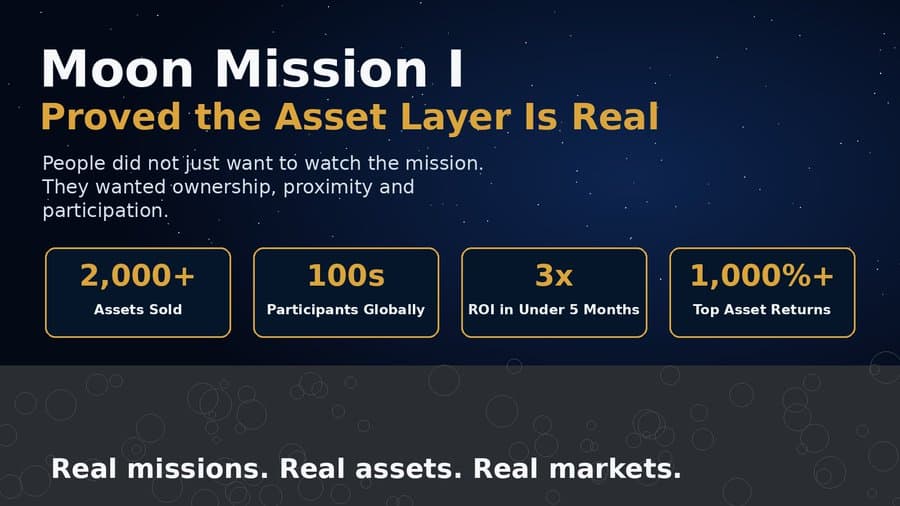
The financial performance mattered, but the behavior mattered more. People wanted proximity to the mission. They wanted ownership. They wanted a piece of something scarce, verified, and real. That is the psychological shift many analysts miss when they reduce space to government contracts, launch cadence, or public company multiples. For most of modern history, the public relationship with space was passive. People watched launches, astronauts, moon landings, governments, and billionaires do things beyond Earth.
The next generation wants participation.
That shift from spectatorship to ownership is one of the most important demand signals in the industry. It suggests that space assets can become cultural, commercial, financial, and institutional products if structured correctly.
Moon Mission I did not prove the entire market. It proved a model and the behavior. It showed that missions themselves can be commercialized, fractionalized, and financed. It showed that space participation can exist outside of equity, grants, procurement, and sponsorships.
Why This Moment Matters for Copernic Space
Copernic Space is entering its growth phase as space is being recognized as an institutional asset class. The timing matters because the market is now validating the problem we have been building around.
Space needs more than rockets. It needs markets, asset structures, secondary liquidity, and financing tools that reduce dependence on government budgets, traditional VC, and public listings. It needs ways for space companies to unlock capital from real assets before a major IPO or acquisition. It needs ways for investors to participate without waiting for the rare moment a company becomes public. It needs ways for mission-level activity to become investable, not only operational.
Our focus is the financial infrastructure for real world space assets. Moon Mission I proved demand. We are preparing secondary market infrastructure around Real World Space Assets. We have access to unique space infrastructure and asset opportunities across reusable rockets, lunar payloads, satellite assets, in-orbit infrastructure, data rights, space-flown commercial and luxury assets, and mission-linked revenue opportunities.
These are exactly the categories public equity cannot provide direct exposure to and traditional VC cannot scale broadly enough. Equity in space companies is important. It should exist in public markets, private markets, and more dynamic secondary markets. But if space is becoming infrastructure, then the assets themselves also need markets.
The next wave of liquidity will not only go to companies building rockets, satellites, or defense systems. It will go to new category creators that define how the space economy is financed, owned, accessed, and traded. That is the opportunity Copernic Space is positioned for.
The Market Has Priced SpaceX. Now It Needs to Build the Rest.
The SpaceX IPO will be remembered as one of the most important capital market events of this generation because it marked the moment space entered the global capital system at full scale. Before this, the question was whether space was real. Now the question is how to access it.
Public stocks matter. Venture capital matters. Private equity matters. Government contracts matter. None of them are enough by themselves. A true space economy needs asset markets, secondary liquidity, mission finance, ownership structures, and ways for capital to participate directly in the infrastructure being built beyond Earth.
The first wave went into companies. The next wave goes into assets. Then the market will demand access, liquidity, ownership, and yield.
The market has priced SpaceX. Now it has to build the financial system for the space economy that comes after it.